Increase Network Bandwidth with Optics
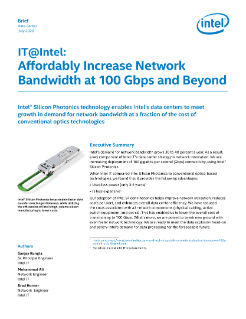
Intel IT is using Intel® Silicon Photonics to affordably increase network bandwidth in Intel's data centers.
Intel’s demand for network bandwidth grows 30 to 40 percent a year. As a result, a key component of Intel IT’s data center strategy is network innovation. Intel IT is increasing deployment of 100 gigabits per second (Gbps) connectivity, using Intel Silicon Photonics.
When Intel IT compared Intel Silicon Photonics to conventional optics-based technologies, they found that it provides the following advantages:
- Uses less power (only 3.5 watts)
- Is less expensive
Intel IT standardized on the CWDM4 MSA QSFP28 model because it can span up to 2 kilometers on SMF. This model can also operate in a wide range of temperatures (0° to 70° Celsius) at low power (3.5 watts), which was important for variety of data center deployments.
Over the last 18 months, Intel IT has deployed more than 8,000 100 GbE ports across Intel and 3,000 Intel® Silicon Photonics Optical Transceiver. The deployment of Intel Silicon Photonics has enabled us to meet the growth in demand for network bandwidth without significantly increasing costs.
Intel IT's adoption of Intel Silicon Photonics helps improve network utilization, reduces costs per port, and enhances overall data center efficiency. Intel IT has reduced the costs associated with all network components (physical cabling, active switch equipment design, and optics). This has enabled Intel IT to lower the overall cost of transitioning to 100 Gbps. What’s more, Intel IT is poised to break new ground with even faster network technology - they are ready to meet the data explosion head-on and satisfy Intel’s demand for data processing for the foreseeable future.